Key takeaways
- Focal length (mm) controls how much of the scene you see — small numbers are wide, big numbers are zoomed in.
- Aperture (f-number) controls light and background blur — smaller f-numbers are "faster".
- Primes have one focal length; zooms cover a range.
- Pick lenses by what you shoot: wide for landscapes, 50–135mm for portraits, long telephoto for wildlife.
Focal length: how wide or how close
Focal length, measured in millimetres, describes a lens's angle of view and magnification. A 16mm lens sees a very wide scene; a 400mm lens sees a narrow slice of it, making distant subjects look big. The categories below use full-frame focal lengths — on smaller sensors, divide by the crop factor to get the same view (for example, 35mm on APS-C ≈ 50mm on full frame).
| Category | Full-frame focal length | What it does | Typical uses |
|---|---|---|---|
| Fisheye | 8–16mm | 180° view with strong curved distortion | Creative, action sports, skateboarding |
| Ultra-wide | 12–20mm | Very wide, exaggerates depth | Landscapes, architecture, interiors, astro |
| Wide | 24–35mm | Shows context, natural but spacious | Travel, street, documentary, vlogging |
| Standard | 40–60mm | Close to how our eyes see | Everyday, street, portraits, food |
| Short telephoto | 70–135mm | Flattering compression, easy blur | Portraits, details, events |
| Telephoto | 135–300mm | Brings distant subjects closer | Sport, wildlife, candid, landscapes |
| Super telephoto | 300mm+ | Extreme reach, very narrow view | Birds, wildlife, motorsport, the Moon |
Aperture: fast and slow lenses
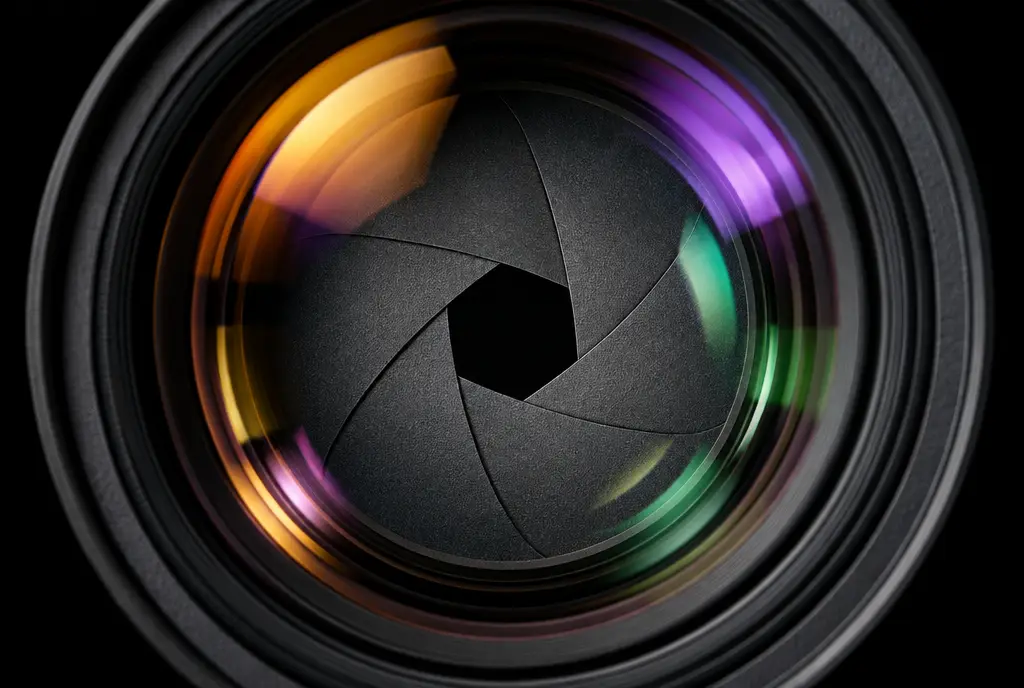
The aperture is an adjustable opening inside the lens. It's written as an f-number: f/1.4, f/2.8, f/5.6 and so on. The smaller the number, the larger the opening. A lens's maximum aperture is printed on it, often as a ratio like 1:1.8.
- Fast lenses (f/1.2–f/2) let in lots of light — great for low light and blurry backgrounds.
- Constant-aperture zooms (e.g. 24–70mm f/2.8) keep the same maximum aperture throughout the zoom range — typical of professional lenses.
- Variable-aperture zooms (e.g. 18–55mm f/3.5–5.6) get "slower" as you zoom in — typical of kit lenses; smaller, lighter and cheaper.
Aperture is one of three exposure controls — see the exposure triangle for how it works with shutter speed and ISO.
Prime vs zoom lenses
Prime lenses (fixed focal length)
- Wider apertures for the price
- Smaller and lighter
- Often sharper at the same price point
- Teach you to "zoom with your feet"
Zoom lenses (variable focal length)
- One lens covers many situations
- Fewer lens changes — less dust on the sensor
- Ideal for travel, events and wildlife
- Frame precisely when you can't move
The main types of lenses
Kit lens
The standard zoom sold with a camera, typically 18–55mm or similar on APS-C and 24–50mm or 28–60mm on full frame. Light, inexpensive and surprisingly capable in good light. Its limitations are low light and background blur.
Standard zoom
The "workhorse" lens: 24–70mm or 24–105mm on full frame, 16–55mm or 17–70mm on APS-C. Higher-quality versions with f/2.8 or f/4 apertures are the most-used lens for many wedding, event and travel photographers.
Travel zoom (superzoom)
One lens from wide to long telephoto, like 18–135mm or 18–300mm on APS-C, or 24–200mm on full frame. Convenience over absolute quality and low-light performance.
Wide-angle & ultra-wide lenses
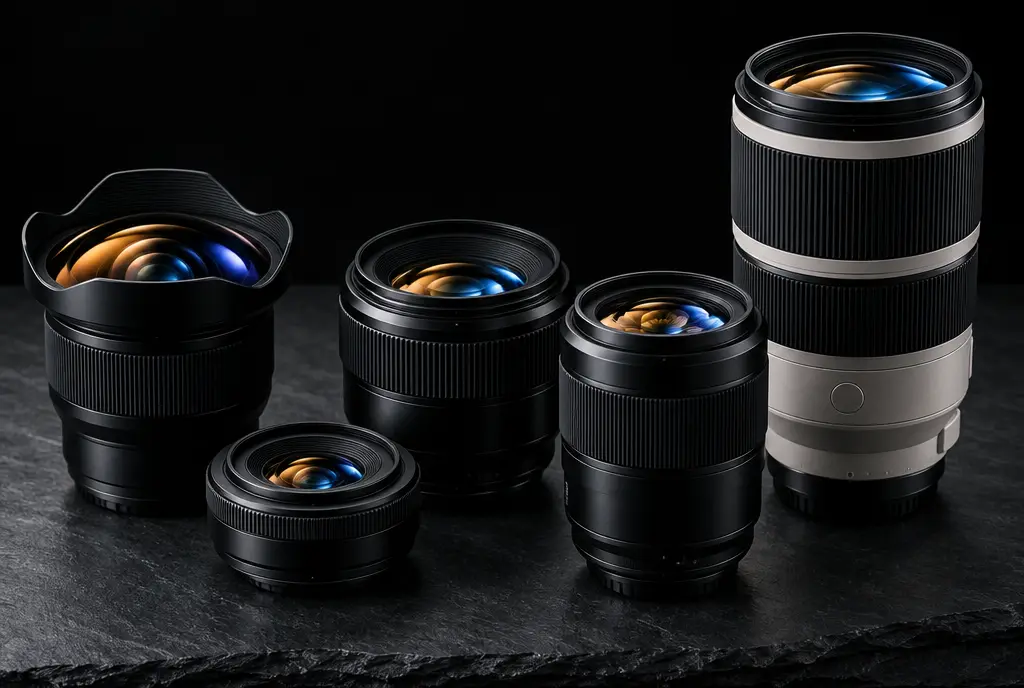
Lenses wider than about 35mm (full frame). They take in big scenes, make foregrounds loom large and help in tight interiors. Fast ultra-wide primes (f/1.4–f/2.8) are favourites for astrophotography.
Standard prime ("nifty fifty")
A 50mm f/1.8 on full frame (or roughly 33–35mm on APS-C, 25mm on Micro Four Thirds) is often the cheapest lens in a system and one of the best value. Great for portraits, low light and everyday shooting.
Portrait lens
Short telephoto primes around 85mm and 135mm, usually with wide apertures like f/1.4–f/1.8. They let you stand at a comfortable distance, flatter facial proportions and melt the background into smooth bokeh.
Telephoto zoom
70–200mm, 70–300mm and 100–400mm-class zooms are the go-to for sport, wildlife, events and compressed landscapes. A 70–200mm f/2.8 is a professional staple; f/4–5.6 versions are much lighter and cheaper.
Super-telephoto lens
Lenses of 400mm and beyond, including 150–600mm, 200–600mm and 200–800mm-class zooms. Essential for bird and wildlife photography. Heavy and often used on a monopod.
Macro lens
Designed to focus extremely close. A "true" macro lens reaches 1:1 magnification, meaning the subject is reproduced at life size on the sensor. Common focal lengths are 50–60mm, 90–105mm and 150–180mm — longer ones let you work further from nervous insects. Most macro lenses also make excellent, sharp portrait lenses.
Fisheye lens
An extreme wide-angle with deliberate barrel distortion, producing a round or strongly curved image with up to a 180° view. Used creatively and in action sports.
Tilt-shift lens
These lenses can shift (to keep vertical lines straight in architecture) and tilt (to change the plane of focus, for front-to-back sharpness or "miniature" effects). Specialist, expensive and manual-focus.
Pancake lens
Extremely thin primes, often just 2–3 cm deep, that make a camera almost pocketable. Ideal for street and travel.
Manual-focus & vintage lenses
Mirrorless cameras adapt old film-era lenses easily thanks to focus peaking and magnification. Vintage glass is a cheap way to get character — glow, swirl and unique flare.
Anamorphic & cine lenses
Made for video, with de-clicked apertures, geared focus rings and (for anamorphic) a wide, oval-bokeh cinematic look.
Which lens for which type of photography?
| Genre | Recommended lenses (full-frame equivalent) |
|---|---|
| Portraits | 50mm f/1.8, 85mm f/1.8, 70–200mm f/2.8 |
| Landscape | 16–35mm, 24–70mm, 70–200mm for compressed views |
| Street | 28mm, 35mm or 40mm prime |
| Travel | 24–105mm or 24–200mm zoom + a small fast prime |
| Wildlife & birds | 100–400mm, 150–600mm, 200–600mm or 200–800mm |
| Sport | 70–200mm f/2.8, 100–400mm, 300mm+ primes |
| Weddings & events | 24–70mm f/2.8, 70–200mm f/2.8, 35mm and 85mm primes |
| Macro | 90–105mm macro (1:1) |
| Astrophotography | 14–24mm f/1.4–f/2.8 |
| Architecture & real estate | 16–35mm, tilt-shift 17–24mm |
| Food & product | 50mm, 90–105mm macro |
| Vlogging | Wide zoom or prime around 16–24mm with stabilisation |
How to read a lens name
Lens names look like code, but they follow a pattern. Take a made-up example: RF 24-105mm F4 L IS USM.
- Mount / system: RF (Canon mirrorless). Others: Z / NIKKOR Z, FE (Sony full frame), E (Sony APS-C), XF / XC (Fujifilm), M.Zuiko (OM System), L-Mount.
- Focal length: 24–105mm.
- Maximum aperture: F4 (constant). F3.5-5.6 would be variable.
- Pro line: L (Canon), S-Line (Nikon), G Master / GM (Sony), Red Badge / LR (Fujifilm), PRO (OM System), Art / Sports (Sigma).
- Stabilisation: IS (Canon), VR (Nikon), OSS (Sony), OIS (Fujifilm, Panasonic), OS (Sigma), VC (Tamron).
- Focus motor: USM / STM (Canon), SWM / STM (Nikon), SSM / XD Linear (Sony), LM (Fujifilm) — "STM" and linear motors are typically quiet, which helps with video.
- Other markers: WR (weather resistant), Macro, DC / DX / APS-C (made for crop sensors), DG DN / Di III (Sigma / Tamron mirrorless lenses).
Other lens specs worth knowing
- Minimum focus distance — how close you can get. Important for food, products and details.
- Filter thread — the diameter (e.g. 67mm) for screw-in filters. Sharing a size across lenses saves money.
- Weather sealing — gaskets against dust and moisture, only fully useful on a sealed body.
- Aperture blades — more, rounded blades usually mean smoother out-of-focus highlights.
- Internal zoom / focus — the lens doesn't extend, which helps balance on gimbals and sealing.
Three sensible starter lens kits
Kit zoom + nifty fifty
Covers everyday shooting plus low light and portraits for the least money.
Travel zoom + small wide prime
One lens for daytime versatility, one fast, compact prime for evenings and interiors.
Standard zoom + 100–400mm
Landscapes and wildlife from a single bag.
Frequently asked questions
What lens should a beginner buy first after the kit lens?
A fast, affordable prime such as a 50mm f/1.8 on full frame, or a 23–35mm f/1.4–f/2 on APS-C. It gathers much more light than a kit zoom, gives attractive background blur and teaches you to compose by moving your feet.
What is the best lens for portraits?
Short telephoto focal lengths between about 85mm and 135mm (full-frame equivalent) are classic portrait lenses because they flatter facial features and blur the background. A 50mm lens is also a popular, budget-friendly portrait option.
What do the numbers on a lens mean?
The first number (for example 24-70mm) is the focal length range. The f-number (for example f/2.8 or 1:2.8) is the maximum aperture — a smaller number means more light and more background blur. A range like f/3.5-5.6 means the maximum aperture gets smaller as you zoom in.
Are zoom lenses worse than prime lenses?
Not necessarily. Modern professional zooms are extremely sharp. Primes are usually smaller, lighter, cheaper for a given aperture and gather more light, while zooms offer flexibility. Many photographers use both.
Do I need image stabilisation in the lens?
If your camera has in-body stabilisation (IBIS), lens stabilisation is less important except for long telephotos. If your camera lacks IBIS, a stabilised lens helps a lot for handheld shooting at slower shutter speeds.