The short answer
- Buy mirrorless. That's where every brand is investing in new cameras and lenses.
- APS-C is the sweet spot for most beginners; full frame makes sense if low light matters most.
- Choose a system for its lenses, not just the camera body — you'll replace the body long before your lenses.
- Start with the kit zoom + one fast prime (such as a 50mm f/1.8 or its APS-C equivalent).
- Budget 10–20% extra for a memory card, spare battery and a strap or bag.
Do you actually need a camera?
Smartphones take fantastic photos in good light, so it's a fair question. A dedicated camera earns its place when you run into the limits of a phone:
- Real optical zoom — wildlife, sport and concerts need focal lengths far beyond a phone's telephoto module.
- Natural background blur — a large sensor and a fast lens produce smooth, realistic bokeh without the edge artefacts of "portrait mode".
- Fast action — modern autofocus can track eyes of people, animals, birds and vehicles at 10–30 frames per second.
- Low light — a bigger sensor collects more light, so night and indoor photos are cleaner with less processing.
- Control and RAW files — you decide aperture, shutter speed and ISO, and get flexible files for editing.
If none of those matter to you, a newer phone may be the better investment. If several do, read on.
Step 1: Decide what you'll photograph
Your subjects decide the lenses you need, and the lenses you need decide which camera system makes sense. Be honest about what you'll shoot 80% of the time:
| You mostly shoot… | What matters | Good starting lens |
|---|---|---|
| Travel & everyday | Small size, versatile zoom | Kit zoom or an 18–135mm-type travel zoom (APS-C) |
| Portraits & family | Eye-detection AF, background blur | 50mm f/1.8 (full frame) or 33–35mm f/1.4–1.8 (APS-C) |
| Kids & pets | Fast, tracking autofocus | Kit zoom + a fast prime for indoors |
| Landscape | Resolution, dynamic range, weather sealing | Wide-angle zoom (e.g. 10–20mm APS-C / 16–35mm FF) |
| Sport & wildlife | Burst speed, subject tracking, reach | 70–300mm or 100–400mm-class telephoto zoom |
| Video & vlogging | Flip screen, stabilisation, mic input | Wide zoom (e.g. 10–18mm APS-C) with stabilisation |
| Street | Small, quiet, discreet | Compact prime around 23–28mm (APS-C) / 35mm (FF) |
Step 2: Set a realistic budget
Think in terms of a kit, not a camera body. Beyond the camera and lens you'll need at least a fast memory card and a spare battery. Rough 2026 price bands for a new camera with its kit lens:
| Budget (camera + lens) | What you typically get |
|---|---|
| Under $700 | Entry-level APS-C mirrorless with a kit zoom, or a good used body. Excellent image quality; simpler controls, often no in-body stabilisation. |
| $700 – $1,300 | Enthusiast APS-C bodies: more dials, better electronic viewfinder, sometimes in-body stabilisation and weather sealing. |
| $1,300 – $2,500 | Entry full-frame bodies with a kit zoom, or a top-tier APS-C camera with a quality lens. |
| $2,500+ | Mid-range full frame with high-end lenses, faster bursts, better video specs and dual card slots. |
If you have to choose, a mid-range body with a great lens beats a top body with a poor lens. Lenses also hold their value far better than camera bodies.
Step 3: Pick the type of camera
We cover every type in detail in Camera Types & Sensor Sizes. Here's the quick version for a first camera:
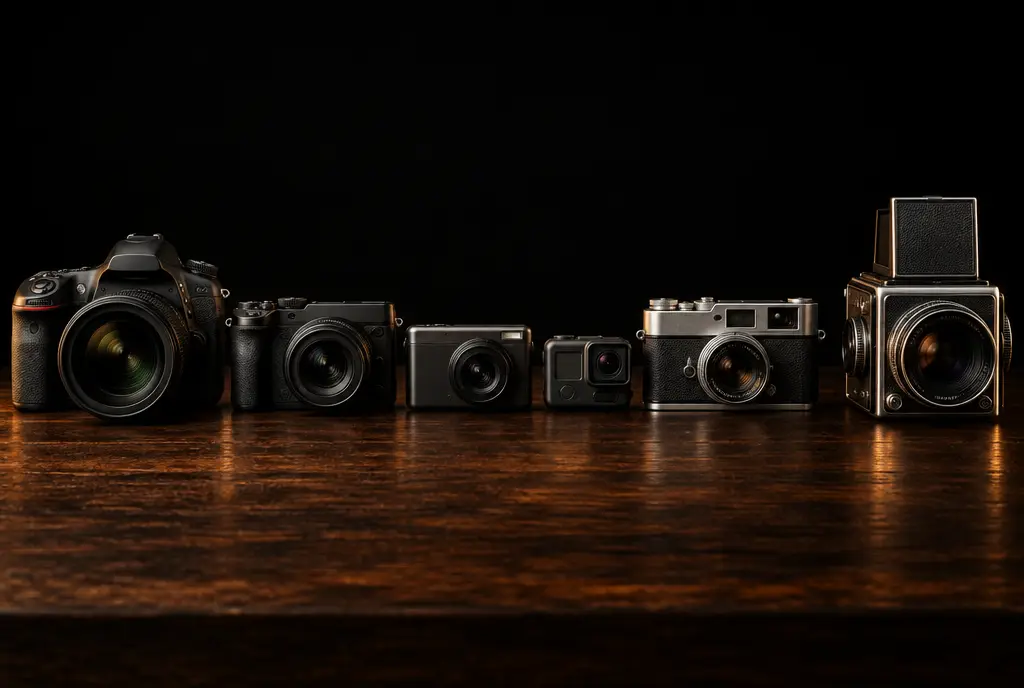
- Mirrorless (interchangeable lens) — the default choice. Compact, excellent autofocus, what you see in the viewfinder is the actual exposure.
- DSLR — still capable, and cheap used, but new lens and body development has largely stopped.
- Premium compact — a large-sensor camera with a fixed lens. Great if you know you'll never change lenses.
- Bridge / superzoom — huge zoom range in one body; smaller sensor means weaker low-light quality.
- Action camera — for helmets, water and POV video, not general photography.
Step 4: Choose a sensor size
Sensor size is the biggest single factor in image character, low-light performance and system size. The three you'll choose between:
APS-C
About 23.5 × 15.6 mm. Excellent quality, compact lenses, most affordable. A 1.5× crop factor (1.6× for Canon) gives telephoto lenses extra "reach".
Micro Four Thirds
17.3 × 13 mm, 2× crop. The smallest and lightest lenses, strong stabilisation. A little more noise at high ISO.
Full frame
36 × 24 mm — the size of 35mm film. Best low-light performance and shallowest depth of field; bigger, heavier and pricier lenses.
Don't overthink it: all three produce professional-quality images. Choose based on size, budget and the lenses you want.
Step 5: Choose a system (lens mount), not just a body
Every interchangeable-lens camera uses a lens mount — the physical and electronic connection between body and lens. When you buy a camera, you're really buying into that mount. Lenses from one mount don't fit another without adapters.
| Brand | Mirrorless mount | Sensor formats |
|---|---|---|
| Canon | RF (RF-S for APS-C lenses) | APS-C, full frame |
| Nikon | Z (DX lenses for APS-C) | APS-C, full frame |
| Sony | E (FE for full-frame lenses) | APS-C, full frame |
| Fujifilm | X / GFX | APS-C / medium format |
| Panasonic | Micro Four Thirds / L-Mount | MFT / full frame |
| OM System | Micro Four Thirds | MFT |
| Leica, Sigma | L-Mount (Leica also M) | Full frame, APS-C |
Before choosing, check three things for the mount: are there affordable lenses for what you shoot, do third-party makers (Sigma, Tamron, Viltrox, Samyang and others) support it, and is there a healthy used market? See Camera Brands Compared for a full breakdown.
Step 6: Which features really matter
Worth paying for
- Subject-detection autofocus — eye/face/animal detection makes sharp photos of moving people and pets far easier.
- Electronic viewfinder (EVF) — much easier to compose in bright sunlight than using the rear screen.
- In-body image stabilisation (IBIS) — sharper handheld shots at slow shutter speeds with every lens.
- Good grip and physical dials — you'll change settings faster and enjoy using the camera more.
- Fully articulating screen — essential for video and vlogging, handy for low and high angles.
Less important than marketing suggests
- Very high megapixels — 24 MP is plenty for most people; 40+ MP mostly means bigger files.
- Maximum burst speed — 10 fps covers nearly everything outside pro sport.
- 8K video — unless you're a video professional, 4K is more than enough.
Step 7: Your first lenses
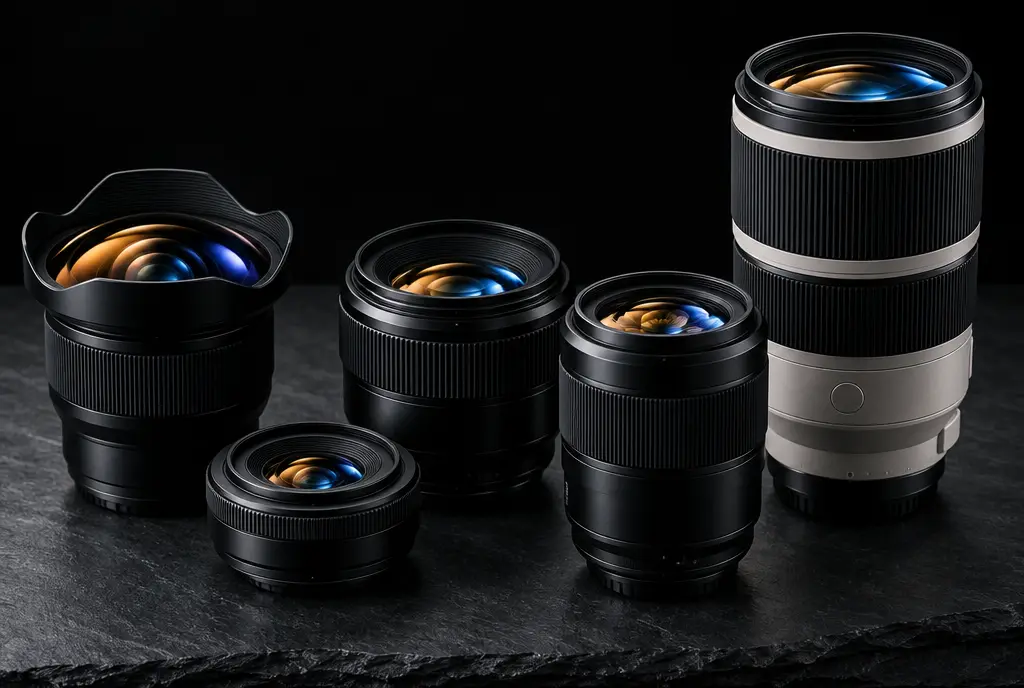
We explain every lens type in Types of Lenses. For a first kit, this simple path works for almost everyone:
- Kit zoom (e.g. 18–45mm, 16–50mm or 18–55mm on APS-C, 24–50mm or 28–60mm on full frame). Versatile and cheap when bundled.
- A fast prime — the classic "nifty fifty" 50mm f/1.8 on full frame, or a 23–35mm f/1.4–f/2 on APS-C. It lets in several times more light than a kit zoom and gives lovely background blur. It's often the single biggest image-quality upgrade you can make.
- Then specialise — a telephoto zoom for sport and wildlife, a wide zoom for landscapes, or a macro lens for close-ups.
After a month with the kit zoom, check the focal lengths of your favourite photos in the image info (EXIF). If most are at the wide end, a wide prime or zoom is your next lens; if they cluster at the long end, get a telephoto.
Popular beginner cameras (examples)
Models change every year, so treat these as examples of well-regarded lines rather than a buying list — always check for the newest generation and compare current prices.
| Category | Examples of popular lines | Why beginners like them |
|---|---|---|
| Entry APS-C | Canon EOS R50 / R10, Nikon Z50 II, Sony ZV-E10 II / a6400, Fujifilm X-M5 | Small, affordable, excellent autofocus and image quality |
| Enthusiast APS-C | Sony a6700, Fujifilm X-S20 / X-T50, Nikon Zfc | More controls, better viewfinders, many with IBIS |
| Micro Four Thirds | OM System OM-5, Panasonic Lumix G-series | Very compact lenses, strong stabilisation, weather sealing |
| Entry full frame | Canon EOS R8, Nikon Z5 II, Sony a7C II, Panasonic Lumix S5 II | Full-frame low-light quality at the lowest price |
New or used?
Cameras lose value quickly in their first two years and then level off, so a lightly used body from the previous generation is often the smartest buy. Lenses keep their value even better.
- Buy from a reputable dealer with a warranty or return period where possible.
- Check the shutter count (it's a wear indicator, like mileage on a car).
- Inspect the sensor and lens glass for scratches, fungus or haze.
- Test autofocus, all buttons, card slot and battery before paying.
- Official refurbished stores from manufacturers are a good middle ground.
Accessories you actually need
| Accessory | Why | Priority |
|---|---|---|
| Fast SD card (UHS-I U3 / V30 or better) | Slow cards cause lag in burst shooting and can't record high-bitrate video | Essential |
| Spare battery | Mirrorless cameras use more power than DSLRs | Essential |
| Strap or wrist strap | Prevents expensive drops | Essential |
| Lens cloth & blower | Keep glass and sensor clean | High |
| Camera bag or insert | Protection and easy carrying | High |
| UV / protective filter | Optional front-element protection; a lens hood also helps | Optional |
| Tripod | Night, landscape and long exposures | When needed |
Final checklist before you buy
- I know what I'll shoot most of the time.
- My budget includes a card, spare battery and strap.
- The mount has affordable lenses for my subjects, including third-party options.
- I've held the camera (or one with a similar grip) and like the handling.
- I've compared the price with the previous generation and used options.
Next, learn how to actually use it: start with the exposure triangle and then camera settings explained.
Frequently asked questions
Is a smartphone good enough, or do I need a camera?
Modern phones are excellent for everyday snapshots in good light. A dedicated camera pays off when you want a real optical zoom, a blurred background from optics rather than software, fast action, low-light quality without heavy processing, or the ability to change lenses.
Should a beginner buy full frame or APS-C?
For most beginners APS-C is the better value: bodies and lenses are smaller and cheaper, and image quality is excellent. Choose full frame if you often shoot in low light, want the shallowest depth of field, and are happy to pay more and carry more.
Should I buy a DSLR or a mirrorless camera in 2026?
Mirrorless. All major brands have moved their new camera and lens development to mirrorless. A used DSLR can still be a great budget buy, but you'll be investing in a system that is no longer growing.
How many megapixels do I need?
20–26 megapixels is plenty for social media, large prints and moderate cropping. Higher resolution only helps if you print very large or crop heavily, and it creates bigger files.
Is the kit lens worth it?
Usually yes. A kit zoom costs little extra when bundled and covers wide to short telephoto. Use it for a few months to learn which focal lengths you use most, then buy a prime or better zoom for that range.
Is it safe to buy a used camera?
Yes, if you buy from a reputable dealer with a warranty or return period. Check the shutter count, look for scratches on the sensor and lens glass, and test autofocus and all buttons.